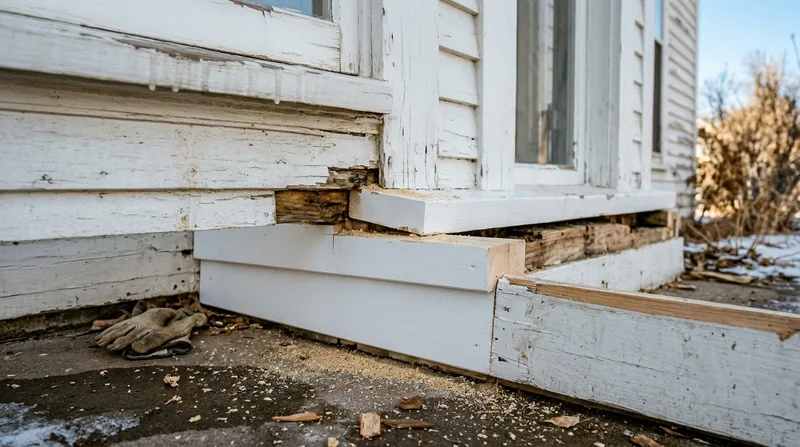




Fort Collins sits at the intersection of the high plains and the foothills, where intense high-altitude sun, freeze-thaw cycles, and heavy spring snowmelt create ideal conditions for wood rot. The city's architectural heritage runs deep: late-1800s and early-1900s brick Victorians and Craftsman bungalows with deep wood porches line the tree-shaded streets of Old Town and the Laurel School area, while 1950s ranch homes with wood trim cluster near Colorado State University, and newer two-story frame homes with substantial decks fill Fossil Creek and the southeast. All of them share a common enemy: water trapped behind siding and fascia by snow, ice dams, and the freeze-thaw cycle that cracks paint and lets moisture back in. Wood rot and dry rot repair in Fort Collins means cutting out decayed framing, sills, and trim, treating surrounding wood, and rebuilding with rot-resistant lumber. This is a permanent structural repair, not a cosmetic patch. We explain what you have, what it will cost, and whether the wood can be saved or needs replacement.
Why Wood Rot and Dry Rot Matter in Fort Collins: The Real Cost of Ignoring Water Damage
Fort Collins wood rots from the top down. Ice dams at the eaves soak fascia and sills each spring. Freeze-thaw cycles crack paint and open seams. The dry, high-altitude air shrinks exposed wood, and intense UV radiation breaks down what little finish remains. Unlike termite damage, which is spotty and localized, moisture-driven rot spreads along the grain and across framing members. A rotted sill plate or rim joist doesn't just look bad; it weakens the structural connection between the foundation and the wall above it. A rotted fascia or soffit allows water into the attic and down into the walls. Left unaddressed, these failures compound: water pools behind siding, rots the rim joist and band board, and eventually reaches the floor joists and subfloor below.
- Rotted fascia and soffit allow water into the attic and eaves, leading to mold and further decay of roof framing.
- Compromised sill plates and rim joists reduce the structural integrity of the connection between foundation and wall framing.
- Decayed floor joists and subfloor create soft spots, sagging floors, and risk of collapse under load.
- Early repair stops the spread and costs far less than replacing entire sections of framing or foundation support.
Catching rot early and removing only the decayed wood saves money and preserves the integrity of your home.
Key info: Fort Collins homes built before 1980 typically have wood sill plates, rim joists, and fascia boards directly exposed to freeze-thaw cycles and snowmelt. The older Craftsman bungalows and Victorians in Old Town and around Avery Park are particularly vulnerable because their deep eaves and porches concentrate water runoff, and their original wood trim often lacks modern paint and sealant protection. A professional inspection can identify soft spots, discoloration, and early rot before structural damage occurs.
For more information on related structural issues, see our guide to floor joist and subfloor repair in Fort Collins.
How We Repair Wood Rot and Dry Rot in Fort Collins: A Step-by-Step Process
Our approach is straightforward: we locate all decayed wood, remove it completely, treat the surrounding framing to prevent future rot, and rebuild with lumber that resists moisture and decay. We do not cosmetically patch or paint over soft wood. We cut it out, examine what caused the failure, and fix the root cause so the repair lasts. Most jobs happen in a single visit or two, depending on the extent of decay and whether structural framing requires sistering or replacement.
- We inspect the affected area with a moisture meter and sharp probe to identify all decayed wood, both visible and hidden behind siding or trim.
- We remove rotted wood by cutting it back to sound material, exposing the full extent of the damage and any water entry points.
- We treat surrounding framing with a wood preservative to arrest decay in wood that shows early softness or staining but is not yet structurally compromised.
- We rebuild the removed section with rot-resistant lumber, typically pressure-treated Douglas fir or redwood, secured with stainless steel fasteners.
- We flash and seal all new wood to prevent water from entering at the repair seam or at the connection to existing framing.
- We finish the repair to match the original profile and appearance, so the repair is invisible once painted or stained.
The result is a permanent repair that addresses the water entry problem and restores full structural capacity.
Real example: A 1920s Craftsman bungalow in Old Town Fort Collins had rotted fascia and soffit along the east side, where snowmelt and afternoon sun created a freeze-thaw cycle. Water had wicked into the rim joist and the first course of floor joists. We removed the entire fascia, soffit, and the outer 8 inches of the compromised rim joist and band board. We sistered new pressure-treated lumber to the remaining floor joists and installed new fascia and soffit with modern flashing and sealant. The repair took two days and cost less than half the price of replacing the entire eave system or underpinning the foundation. The homeowner's insurance company accepted documentation of the repair for their records.
For structural framing concerns, see our page on framing and structural carpentry in Fort Collins.
Wood Rot Repair Methods: Repair vs. Replace
| Approach | Description | Best for |
|---|---|---|
| Localized decay removal and sistering | Cut out rotted section, treat surrounding wood, attach new pressure-treated lumber alongside remaining sound framing with stainless fasteners. | Sill plates, rim joists, floor joists, or fascia where rot is limited to one face or edge and the core of the member is still sound. |
| Full member replacement | Remove the entire rotted framing member and install new pressure-treated or decay-resistant lumber in its place, with new fasteners and flashing. | Fascia, soffit, sill plate, or short beam sections where rot has compromised more than 30 percent of the cross section or where the member spans a short distance. |
| Epoxy consolidation and sealing | For trim, casing, or decorative elements, inject epoxy into early-stage decay, sand smooth, and refinish with paint and sealant to arrest rot and preserve the original profile. | Historic trim, crown molding, or casing where replacement would alter the character of a heritage home and decay is caught early. |
| Water source elimination and preventive treatment | Install or repair flashing, extend gutters, improve grading, and apply water-resistant sealant to exposed wood to prevent future rot in vulnerable areas. | Any repair, to stop the cause of rot (ice dams, poor drainage, or exposed grain) and extend the life of surrounding wood. |
Wood Rot and Dry Rot Repair Cost in Fort Collins: What to Expect
Wood rot repair in Fort Collins typically starts at around $650 for a small, localized repair such as a rotted fascia section or sill plate on a single wall. The final cost depends on how much wood is decayed, how deep the rot goes, whether structural framing is involved, and how accessible the damage is. A full fascia replacement on a ranch home might run $1,500 to $2,500. A compromised rim joist or floor joist repair, depending on length and whether sistering or full replacement is needed, ranges from $1,200 to $3,500 or more. Jobs involving load-bearing structural members or extensive decay across multiple framing members typically require an on-site estimate because the scope cannot be assessed from a photograph or phone call.
Several factors move the cost up or down. If the decay is hidden behind siding or trim, we must open walls to see the full extent of damage before we can quote accurately. If the rot has spread to multiple members or reached the subfloor, the repair becomes more involved. If the home is on a hillside or the damaged area is difficult to access, labor time increases. If the work is urgent (for example, a storm has opened a wall to weather), we prioritize the job and may schedule it sooner, but we do not charge a premium for emergency service.
Pricing example: A 1970s bi-level in Midtown Fort Collins with rotted cedar siding and a soft fascia along the north side had early rot in the rim joist where the soffit met the wall. The homeowner obtained two estimates. One contractor proposed replacing the entire eave system and sistering the rim joist, quoted at $3,800. We diagnosed the rot as limited to the fascia and the outer 6 inches of rim joist, treated the surrounding wood, sistered new pressure-treated lumber, and installed new fascia and flashing. The repair cost $1,650 and took one day. The homeowner's insurance covered part of the cost under the water damage provision of the policy.
Getting 2 to 3 estimates is always smart. Each contractor may propose different solutions (repair vs. replace, extent of framing involved, choice of lumber), and the estimates will differ accordingly. For a detailed breakdown of typical pricing for various repair types, see our pricing page.
Wood Rot and Dry Rot Repair Near Me: What to Look for When Hiring a Carpenter in Fort Collins
Hiring the right carpenter matters. The person who diagnoses the rot and proposes the repair should be the person who does the work. They should explain what caused the decay, show you the extent of damage, and tell you plainly whether repair is enough or replacement is necessary. They should be fully insured and able to provide references from recent jobs in your neighborhood. They should be willing to get a permit if the work is structural or affects a load-bearing wall, and they should explain what the permit process involves and who pays for it.
Check references and ask previous customers about the quality of the repair, whether the work was clean and on time, and whether the carpenter explained the problem clearly. Ask whether the carpenter has experience with the age and style of your home. A Craftsman bungalow in Old Town requires different knowledge than a 1990s frame house in Fossil Creek, and a carpenter who has worked on both brings valuable perspective. Confirm that the carpenter is fully insured and can provide a certificate of insurance. Ask about the warranty on the repair and what it covers. Most wood repairs carry a one-year warranty against defects in workmanship and materials.
If your home is in a historic district or a deed-restricted neighborhood, check with the homeowners association or the city's Historic Preservation Office before you start work. Some repairs may require approval, and some may have restrictions on materials or appearance. The Fort Collins Planning and Development Services office can clarify whether your property has historic protections or HOA requirements. Get the estimate in writing, and make sure it includes the scope of work, the lumber and materials to be used, the timeline, and the total cost. A professional carpenter will never ask for payment in full upfront; a typical arrangement is one-third down, one-third upon delivery of materials, and one-third upon completion.
For a free estimate and to discuss your specific situation, contact Fort Collins Carpentry at (970) 818-5680.
Wood Rot & Dry Rot Repair in Fort Collins: Pricing Guide
| Service | Price | Details |
|---|---|---|
| Small localized repair (fascia, sill, trim section) | Starting at $650 | Includes removal of rotted wood, treatment of surrounding framing, new pressure-treated lumber, and finishing to match existing. |
| Fascia and soffit replacement (single section or wall) | Starting at $1,500 | Full fascia removal and replacement, soffit repair, flashing installation, and paint or stain finish on one or two sides of home. |
| Rim joist or floor joist repair (sistering or partial replacement) | Starting at $1,200 | Localized decay removal, sistering new pressure-treated lumber, and treatment of surrounding framing; cost depends on length and access. |
| Extensive structural repair (multiple members, large decay area) | On estimate | Full assessment required on site; cost depends on extent of decay, structural requirements, and whether permits and engineering are needed. |
| Travel and mobilization | Included | No separate travel charge or mileage fee within Fort Collins and surrounding service areas including Loveland, Greeley, Windsor, and Timnath. |
| Free estimate | Free | Response within 24 hours at (970) 818-5680; no obligation to book; includes site inspection and written quote. |
Indicative pricing, the exact cost depends on square footage, finish, and site access. Free personalized estimate within 24h at (970) 818-5680.


